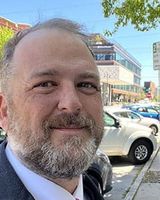
Mission Details
Target: Keith Skelton
Theater: Sallisaw, OK
Operation: FULL HOUSE
Description: Exposure of financial mismanagement and "tyrannical" behavior; public pressure campaign at commission meeting.
Disposition: TACTICAL RETREAT — Separation Agreement / Contract not renewed.
It started with a broken headlight. Or rather, a high beam that was allegedly out in the middle of the day. That was the justification Officer Houston Murray used to pull over Sallisaw resident Sean Buckner on a routine afternoon. It seemed like a minor, even absurd, traffic stop. But that moment pulled a single thread, and what unraveled behind it would expose one of the most troubled small-city governments in Oklahoma.
The Man at the Center: Keith Skelton
Keith Skelton was the City Manager of Sallisaw, Oklahoma, a position that placed him at the operational helm of municipal government. He controlled budgets, he shaped policy, and by multiple accounts gathered during this investigation, he wielded that power like a personal instrument. Residents who had watched his tenure described it using a word that does not often appear in polite civic discussion: tyrannical. Guerrilla News correspondents arrived in Sallisaw to find a city simmering, citizens frustrated, and a commission that had quietly begun to ask questions it should have asked years earlier. When our team positioned outside the Sequoyah County Courthouse for a live press conference, the crowd that gathered was not manufactured. These were neighbors, taxpayers, and people who had watched their city government operate in the dark for far too long.
A Police Department Nobody Should Feel Safe With
To understand what Skelton's management enabled, you have to look at the police department he helped oversee. The picture that emerges from this investigation is not a portrait of isolated incidents. It is a pattern.
Houston Murray, the officer who stopped Sean Buckner, was not a routine hire. According to records and sources reviewed by our correspondents, Murray had deserted the United States Navy not once but twice. The first desertion earned him a special court-martial. The second earned him a general court-martial conviction. He was, by the account of those at the Sallisaw press conference, a convicted felon walking the streets of that city with a badge and a gun, drawing a taxpayer-funded paycheck. A Marine veteran who attended the press conference asked the question that hung over the room like smoke: why did Chief Franklin hire a man who deserted twice, and how did he keep him employed for nearly two decades?
Murray's record would be troubling enough on its own. But it does not stand alone. Our investigation also surfaced the case of Jason Price, a man with a documented mental health history who had been transported to a hospital on each of his three prior encounters with Sallisaw police. On the fourth encounter, he was arrested instead of hospitalized. He was placed, unsupervised, in the back of Officer Lolita Armor's patrol vehicle. By the time Armor arrived at the police station, roughly thirty minutes later, Price had used the seat belt to strangle himself. He was dead. The city's response was silence.
Then there was the case of a man named Waty, who was walking down the street after a report circulated that he might, possibly, be a prisoner who had not been properly released. He never made it home. Two Sallisaw police officers shot and killed him. And then there was an incident at a horse stable where Officer Houston Murray, the twice-convicted deserter, was present when a fellow officer, a woman named Desa Nef, was shot. According to sources present at the press conference, a firearm in Murray's holster discharged and struck Nef. Murray subsequently left law enforcement. He became a schoolteacher.
The school connection does not end there. A separate Sallisaw officer was removed from his position as a school resource officer following allegations of sexual contact with a student. That officer, identified as Blake Griffy during the public press conference, had been embedded in Sallisaw public schools before those allegations surfaced.
Across all of these incidents, one detail recurred with disturbing frequency: body cameras that were not activated. When Guerrilla News correspondents confronted Chief Franklin directly in the lobby of the commission meeting hall, asking why officer-involved shootings consistently lacked body camera footage, he offered three words. No comment.
The Records Wall
Every accountability investigation eventually hits a wall of paper, or rather, the absence of it. Sallisaw built that wall with bureaucratic precision. Sean Buckner, the resident whose traffic stop ignited this inquiry, described the experience of requesting public records from the city as playing alphabet soup word games. One misspelled word in a request, he said, and the city would simply refuse compliance. Requests had to be filed again and again before anything was produced. Perseverance, Buckner noted, did eventually prevail. But it should not have required perseverance to obtain documents that belong to the public.
A separate encounter captured on camera illustrated just how hostile the city's posture toward transparency had become. When Guerrilla News correspondents traveled to the nearby city of Wagner to request open records in person, a city employee identified during the interaction only as a large, bald staff member refused to assist, then ordered the correspondents to leave the public lobby. When they declined, citing their legal right to remain in a public building, the employee called the police. Officers responded, reviewed the situation, confirmed that no law had been broken, and acknowledged the correspondents' right to record and remain. The employee who made the call had wasted law enforcement resources and accomplished nothing except ensuring that his conduct was captured on film and broadcast to a live audience of hundreds. Meanwhile, the records request that prompted the confrontation remained unfulfilled, because the city clerk was not at her post and no backup process existed to handle public records requests in her absence.
The Commission Meeting That Changed Everything
By the time Guerrilla News correspondents arrived outside Sallisaw City Hall for the commission's special meeting, the city's momentum had shifted. Inside, commissioners convened to discuss, in the careful language of municipal government, the performance of the city manager, a separation agreement, and a contract renewal. They voted to enter executive session, shielding their deliberations from the citizens who had packed the room and who had driven, in some cases, significant distances to be present.
Keith Skelton sat in a blue shirt near the front, visible to cameras, unavailable for comment. When correspondents called out a greeting, he did not respond. He had, on a previous occasion, reportedly told a Guerrilla News correspondent exactly what he thought of the coverage using language not suitable for print. This time, he said nothing. The room waited. Citizens chatted, commissioners deliberated behind closed doors, and the cameras kept rolling.
When the session concluded, the outcome aligned with what residents had been demanding for months. Skelton's contract was not renewed. A separation agreement was reached. The city manager who had, according to multiple sources, run Sallisaw's government like a personal fiefdom, who had overseen a police department riddled with misconduct, who had presided over a culture of records obstruction and open meetings violations, was out.
What Remains Unresolved
Skelton's departure is a beginning, not an ending. Chief Franklin, who refused to answer a single substantive question during the commission meeting, remained in his position. The elected structure of Sallisaw's police chief role means that even a chief who presides over a department with a deserter-turned-officer, a custody death, a fatal shooting, and a school resource officer accused of sexual misconduct cannot be removed by simple administrative action. The community was advised during the public press conference to change that structure, to move toward a commission-approved appointment model rather than a direct election, so that accountability flows in a clear direction.
A petition for a state grand jury was announced at the courthouse press conference, aimed specifically at investigating the conduct of officers including Murray, and the circumstances surrounding Bobby Joe Tagle, a woman who was handcuffed to a bench during her detention and whose orbital socket was allegedly broken by Murray after she reflexively kicked him in response to the confinement. Photographs of her injuries were referenced during the press conference. The jail footage documenting that encounter had, as of the press conference date, still not been fully produced in response to records requests.
The residents of Sallisaw who stood in the Oklahoma heat outside their courthouse, who filed into a commission meeting room and waited through an executive session and hours of procedural maneuvering, they won a partial victory. A city manager whose conduct had drawn the attention of a national civil rights inquiry was removed from power. But the officers remain. The records gaps remain. The culture that made all of it possible remains.
The investigation into Sallisaw is not closed. It is ongoing. If you have information about misconduct in Sallisaw or any other Oklahoma municipality, contact Guerrilla News through the link below. And if you believe government should be forced to operate in the light, share this story. Every view, every share, is pressure that bureaucracies like this one cannot ignore.
Everyone can join the discussion with a free account. Members get a badge, their comments stand out, and they are eligible for the pinned Top Comment. Join from $7 a month.