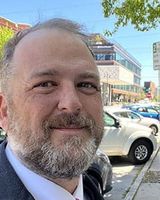

This is Part 1 of a two-part series on Oklahoma's promise to treat addiction instead of jailing it. Part 2: Oklahoma Saved $202 Million by Not Imprisoning Drug Users. Counties Got $37.5 Million.
Oklahoma City police went under an Interstate 40 overpass to serve warrants on Danny Ellerd.
He weighed 92 pounds. His hand was infected from years of injecting drugs. The officers decided he was too sick to book, and took him to a hospital instead of the county jail.
A few years later, Oklahoma State University-Oklahoma City (OSU-OKC) graduated him with two associate degrees and a 4.0 grade point average.
That is the version that went viral this summer. It has been shared across Facebook, rewritten by aggregator sites at home and overseas, and posted under headlines about miracles.
Here is the part the viral version leaves out: who actually paid for his way back. It was not the treatment fund Oklahoma voters created for people exactly like him. That fund did not send a dollar to a single county until 2023.
What the Records Confirm
We are going to be straight with you about what we could check and what we could not.
The OSU Foundation's own Women for OSU page lists Danny Ellerd among its 2025 student scholarship recipients, studying Computer Information Systems, hometown Oklahoma City. The scholarship recognizes academic achievement and service.
Ellerd runs a GoFundMe under his own name to give away 1,000 copies of his book, Recovery Is Possible, to people who are homeless or in active addiction. As of September 28, 2026, it showed $3,325 raised toward a $10,000 goal from 27 donations.
On LinkedIn, Ellerd wrote that he had completed his second degree from OSU-OKC with a 4.0, and that 44 months earlier he was homeless and "holding a sign on the corner to feed my addiction."
The rest, including the overpass, the 92 pounds, the infected hand and the officers' decision, comes from Ellerd's own public accounts, the recovery ministry that took him in, and the stories built on them. We found no police report or news interview with the officers. The accounts also disagree on details: most say about 15 years of addiction, some say nearly 20.
None of that changes the story. It does mean you should know where it comes from.
Too Sick to Book
The decision under that overpass matters more than any other in this story.
In February 2020, The Frontier analyzed state medical examiner data and found nearly 180 people had died in Oklahoma jail custody, or after becoming injured or ill in a jail, since the start of 2014. At least 52 were suicides. About two dozen died from causes tied to drug use.
In 2019 alone, 20 people died after becoming injured or ill in Oklahoma jails. According to The Frontier, only one of them had been convicted of the crime they were held on.
The Frontier also found that state jail standards require an intake questionnaire, but not medical personnel to administer it.
Put a 92-pound man with a spreading infection and severe opioid dependence into that system, and the likeliest ending is not a graduation gown.
The officers made a judgment call. It was the right one. But it was a judgment call, not a policy, and nobody can promise the next officer makes it.
Who Actually Carried Him
After the hospital, the accounts agree, Ellerd went to Hope Is Alive, a faith-based recovery ministry that runs sober-living homes in the Oklahoma City area. He arrived with a Walmart bag of clothes. Over time he became a sponsor and helped manage a recovery home, according to those accounts.
Hope Is Alive is a private ministry. It is not a state program.
In August 2023 he enrolled full time at OSU-OKC. The widely shared accounts, including one built on OSU material, place him in the school's Center for Social Innovation (CFSI).
CFSI is a nine-month program for students with histories of incarceration, addiction, homelessness, trauma and abuse. OSU's own magazine says participants are referred after finishing addiction recovery or prison diversion programs. They earn 12 academic credit hours, plus work-readiness training, career services and internships.
Now look at how OSU says CFSI was paid for:
| Funder | What OSU reported |
|---|---|
| E.L. and Thelma Gaylord Foundation | $1 million, three-year commitment that made CFSI possible |
| Inasmuch Foundation, Merrick Foundation, Simmons Bank, private donors | Additional funding and support (amounts not listed) |
| Federal government, via U.S. Rep. Stephanie Bice | $850,000 congressional allocation |
Bice's office filed the request on April 28, 2021, as fiscal year 2022 Community Project Funding, the program formerly known as earmarks.
A private ministry. Private foundations. A bank. A one-time federal earmark.
That is the whole story of who funded the pieces we could document.
The Fund That Wasn't There
In 2016, Oklahoma voters passed State Question 780, which made simple drug possession and some low-level property crimes misdemeanors instead of felonies. They also passed State Question 781, which told the state to calculate the prison savings and send that money to counties for mental health and addiction treatment.
Ellerd's recovery is exactly the outcome SQ 781 was sold on: someone diverted from a cell, stabilized, treated, housed and put back to work.
But the statute said the savings would go to counties "subject to appropriation by the Legislature." The Legislature did not appropriate. When The Frontier published its jail investigation in 2020, more than three years after the vote, the fund had received nothing.
Money finally started flowing in 2023. By an August 2025 accounting, the state had saved $202.3 million from reduced incarceration and invested $37.5 million in county services.
One Man Is Not a System
Stories like this get used as proof. Proof that recovery is possible. Proof that people under overpasses are not lost causes.
Both of those are true. Ellerd is proof of them.
He is not proof that Oklahoma has a system that works. What carried him was an officer's discretion, an emergency room, a ministry's spare bed, a family foundation's gift and a congressional earmark. Every one of those could have been missing.
The people still under the I-40 overpasses are counting on luck. Voters tried to replace luck with a line item.
What to Do
- If you or someone you know is in recovery or leaving incarceration, OSU-OKC says CFSI is open to anyone with barriers such as incarceration, addiction, trauma, poverty, homelessness, abuse, mental health disorders or domestic violence. The application details are on the CFSI page linked below.
- Find out whether your county has applied for SQ 781 money. Only county commissioners can submit the application. Ask yours at the next meeting: Has this county applied to the County Community Safety Investment Fund? For how much? For what program?
- If you want to help Ellerd's book project, the GoFundMe is linked below. Read it yourself first; we have not audited it.
- Read Part 2 before you talk to your legislator about the budget.
He made it out.
The question is whether the next person has to be as lucky.
Editor's Note
The account of Danny Ellerd's arrest, hospitalization and recovery is drawn from his own public posts, Hope Is Alive's published story of his recovery, and widely shared accounts from summer 2026. Guerrilla News has not independently reviewed police, hospital or court records. The scholarship listing is drawn from the OSU Foundation's Women for OSU page; the fundraising figures are from his GoFundMe page as viewed September 28, 2026. CFSI's funding sources are drawn from OSU's State Magazine (Fall 2022) and Rep. Stephanie Bice's Community Project Funding disclosure (April 28, 2021). Jail death figures are from The Frontier's February 5, 2020 investigation.
No allegation of wrongdoing is made against Danny Ellerd, Hope Is Alive, OSU-OKC or any officer described here.
Corrections: ron@guerrilla.news
Sources
- Scholars – Women for OSU, OSU Foundation. osugiving.com
- Recovery Is Possible: Donate a Book, Change a Life – GoFundMe (fundraiser by Danny Ellerd). gofundme.com
- Danny Ellerd – LinkedIn profile. linkedin.com
- Recovery is Possible: The Story of Danny Ellerd – Hope Is Alive. hopeisalive.net
- For those struggling with addiction or mental health, Oklahoma jails can be deadly – The Frontier, Feb. 5, 2020. readfrontier.org
- OSU-OKC's Center for Social Innovation to receive congressional funding – OSU State Magazine, Fall 2022. news.okstate.edu
- Community Project Funding request, OSU-OKC Center for Social Innovation – Office of Rep. Stephanie Bice, April 28, 2021. bice.house.gov
- About CFSI – Oklahoma State University-Oklahoma City. osuokc.edu
- The voters made a promise with SQ 781; the Legislature has yet to fulfill it – Tulsa World, Jan. 19, 2020. tulsaworld.com
- Groundbreaking report reveals more than $200 million in savings from Oklahoma justice reform – Oklahoma Policy Institute, Aug. 8, 2025. okpolicy.org
- Oklahoma SQ 781 & the County Community Safety Investment Fund – Oklahoma Department of Mental Health and Substance Abuse Services. oklahoma.gov
Everyone can join the discussion with a free account. Members get a badge, their comments stand out, and they are eligible for the pinned Top Comment. Join from $7 a month.